
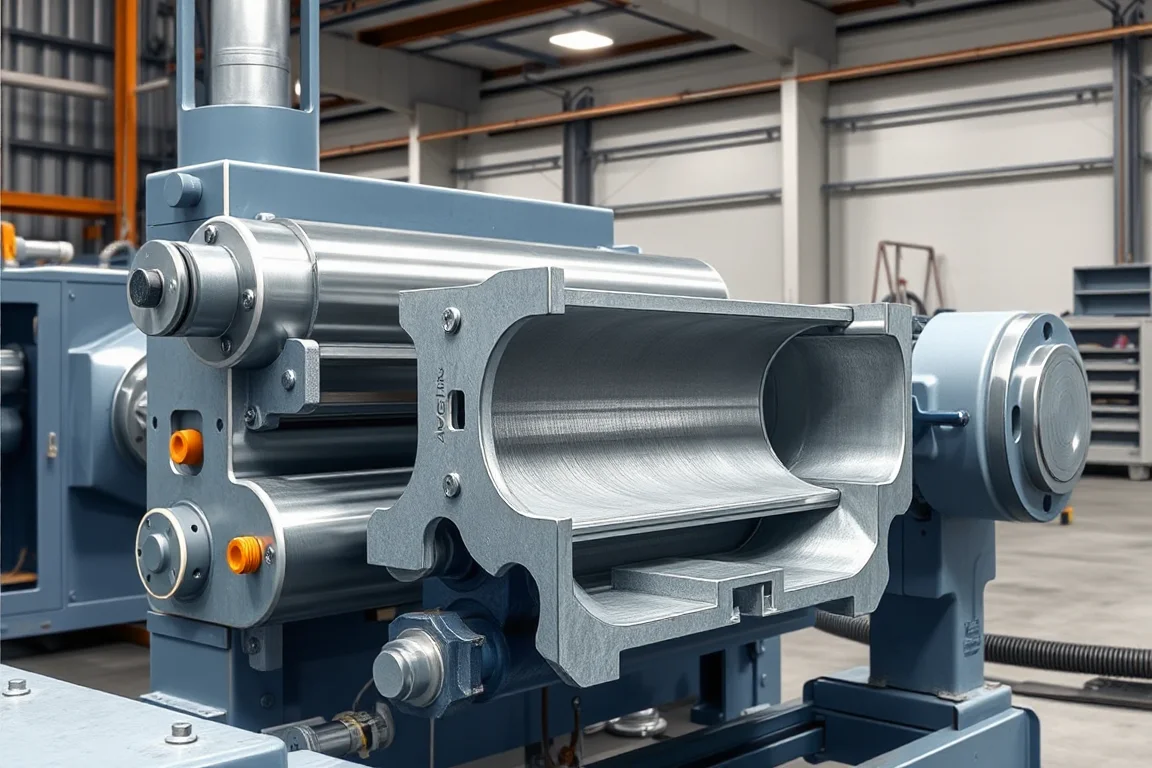
Roller shutter slats are not simply lengths of formed metal; they must articulate, interlock, and coil as a continuous curtain. The roller tooling design is the engineering link between flat strip and a working assembly. This article explains how forming sequences, interlock development, material behaviour, and cutoff choices interact, so you can ask informed questions and evaluate a proposed line.
What role does roller tooling design play in a shutter roll forming machine?
Roller tooling shapes the strip progressively through a series of matched upper and lower rolls. Each pass adds a controlled amount of bend until the final cross-section meets the slat profile. The design must account for the strip's springback, thickness variation, and coating integrity. A roll count alone says little; what matters is how each bend develops, which surfaces locate the strip, and how the tooling accommodates material differences without damaging the interlock edges.
How do the forming sequence and interfaces work together?
The sequence typically begins with edge preparation and pilot forming, then develops the interlock hooks, the main face curvature or flatness, and any stiffening ribs. The strip must be guided positively at each pass. Interfaces between passes matter because minor misalignment accumulates. After forming, the profile may pass through optional perforation or insulation stations, then a cutoff that must support the hollow or interlocked section. If the cutoff does not match the formed geometry, the cut end can distort or the interlock can be crushed. Assembly with guides and end locks is a separate operation; forming accurate slats is necessary but not sufficient for a smooth-moving curtain.
Why interlock geometry deserves close attention
The interlock is the functional heart of a roller shutter. It must allow adjacent slats to rotate relative to each other while resisting separation under wind load or attempted forced entry. The hook and receiver profiles need clearance for articulation, yet enough overlap to stay engaged. Coating on the interlock edges can be abraded if the forming radii are too tight or if the strip is over-constrained. The tooling design should protect the coating at these edges and provide a defined gap that accounts for material thickness and any expected variation. During acceptance, assemble several slats with the intended guide and end locks, then check movement and clearances. Inspect the interlock coating and cut ends for damage.
Material considerations: coated steel and aluminium
Shutter slats are commonly made from coated steel or aluminium. Each material behaves differently during forming. Aluminium is generally more ductile and may spring back differently than steel. Coated steel may have a zinc or paint layer that can crack if bend radii are too small. The tooling design should specify suitable bend radii for the intended material and thickness range. Because the buyer specifies base-metal thickness and grade, the supplier must verify the operating range. Insulated slats with foam filling or sandwich construction require additional processing steps and may not run on a standard single-skin line. Perforation for ventilation also affects stiffness and edge distortion; it should be evaluated as part of the design, not added as an afterthought.
Roll design and strip control
Rolls are not just shaped wheels; they position the strip. Every pass should have a clear locating strategy, whether by the strip edge, a pilot feature, or the forming face. Without positive control, the strip can wander, causing interlock mismatch or edge waviness. Springback compensation is built into the roll profiles, but it cannot be a fixed correction for all materials. The design should allow for fine adjustment or interchangeable tooling to accommodate different batches. Tool access matters too: changing rolls or adjusting for a different profile should not require dismantling the entire line. Keep the accepted setup and tool identification together so production does not depend on an undocumented adjustment.
Cutoff, perforation, and secondary operations
The cutoff press or shear must support the profile internally to prevent collapse. The cut length and end quality are important because slats may need to fit end locks or guides. A profile-supported cutoff uses a mandrel or matching die that holds the interlock and face during cutting. Secondary operations such as perforation for ventilation, embossing, or insulation foaming need their own tooling and may affect line speed or strip tracking. Evaluate these operations together with the forming rolls, not as isolated additions.
Insulated and sandwich slats: a different tooling challenge
Foam-filled slats and sandwich garage-door panels require more than a standard single-skin forming line. The forming process may create a cavity that is later filled, or the slat may be assembled from two skins with an insulating core. Joining methods such as adhesive bonding or mechanical locking need dedicated equipment. The roller tooling must produce consistent mating surfaces for the insulation and joining process. If your product includes insulated slats, confirm the entire process chain from forming to assembly, because a line designed for single-skin slats may not be adaptable without significant changes.
Comparing tooling design alternatives
When evaluating a proposed tooling design, consider the trade-offs between fixed and adjustable rolls, the number of forming passes, and the use of generic versus profile-specific rolls. More passes can distribute strain more gently, but increase cost and setup time. Adjustable rolls offer flexibility for material variation but can be misadjusted. Profile-specific rolls with dedicated locating features generally give better consistency for a defined product family, but limit future changes. There is no universal answer; the right choice depends on your product mix, expected material range, and production volume. Ask how the design handles material variation and access to the final section.
How to assess tooling quality and acceptance
Acceptance should be based on assembled performance, not just individual slat dimensions. Assemble multiple slats with the intended guide and end locks, then check movement and clearances. Inspect the interlock coating and cut ends for damage. Confirm that the curtain coils and articulates as intended. Look for consistent interlock engagement along the length and across multiple slats. Check for edge waviness, twist, or camber that could affect assembly. If perforation is present, verify that it has not caused distortion. The acceptance criteria should be agreed in advance, using the actual material and profile extremes.
Practical checklist for reviewing a tooling proposal
- Identify functional dimensions and mating parts: interlock, guide clearance, end-lock detail.
- Review punch and cutoff tooling together with the roll tools, not separately.
- Verify tool changes using the agreed material and profile extremes.
- Ask how bends develop, which surfaces locate the strip, and how springback is addressed.
- Confirm that the design accounts for material variation and access to the final section.
- Check that the cutoff supports the profile and end quality meets assembly needs.
- For insulated or perforated slats, confirm additional processing and its effect on stiffness.
- Agree on acceptance criteria and keep the accepted setup and tool identification together.
FAQ: Roller shutter roll forming machine roller tooling design
How many forming passes are needed for a shutter slat?
The number of passes depends on the complexity of the profile, the material thickness and grade, and the bend radii. A simple flat slat with a basic interlock may require fewer passes than a curved, insulated, or perforated profile. More passes can reduce strain per pass and improve surface quality, but they also increase tooling cost and setup time. The design should be based on the specific profile and material, not a universal number.
Can one set of rollers produce different slat profiles?
Typically, no. Roller tooling is designed for a specific cross-section. Some adjustment may be possible for material thickness or minor dimensional variation, but changing the fundamental profile—such as from flat to curved or from single-skin to insulated—requires different tooling. If product flexibility is important, consider modular or interchangeable tooling sets, but recognize that each profile needs its own validated setup.
How is springback compensated in the roll design?
Springback is the elastic recovery of the material after bending. Roll designers compensate by overbending the strip slightly, so it relaxes to the desired angle. The amount of overbend depends on material properties, thickness, and bend radius. Because these vary, the tooling may include adjustment features to fine-tune the final shape. The design should allow for this adjustment without compromising strip control.
What causes interlock coating damage during forming?
Coating damage can occur if the bend radius is too tight, if the strip is over-constrained and forced to slide against rough tooling, or if the interlock is formed with excessive pressure. The tooling design should provide adequate radii, polished contact surfaces, and controlled clearances. During acceptance, inspect the interlock coating for scratches or flaking, especially after assembling slats and testing movement.
How should perforation be evaluated in tooling design?
Perforation creates holes in the slat, which can reduce stiffness and may cause edge distortion if not properly supported. The perforation station should be integrated into the line with adequate strip support, and the tooling should be designed to avoid burrs or deformation. Evaluate the perforated slat for flatness, interlock integrity, and coiling behaviour, as these can affect the final curtain.
What acceptance tests should be performed on formed slats?
Assemble multiple slats with the intended guide and end locks, then check movement and clearances. Inspect the interlock coating and cut ends for damage. Verify that the curtain coils and articulates smoothly. Check for consistent interlock engagement and absence of twist or camber. The acceptance criteria should be agreed in advance, using the actual material and profile extremes.
Keeping production consistent
Once a tooling setup is accepted, document the roll positions, shim settings, and any adjustments. Keep this record with the tool identification so that future setups can be repeated. Production consistency depends on controlled material input and regular tooling maintenance. Inspect rolls for wear, especially at the interlock forming surfaces, and replace or recondition them as needed. A well-designed tooling package, combined with disciplined setup control, is what turns flat strip into a reliable shutter curtain.
Continue your research
- Roller Shutter Door Roll Forming Machines
- Roller Shutter Slat Roll Forming Machine
- Rolling Shutter Guide Rail Roll Forming Machine
- Flat Roller Shutter Slat Roll Forming Machine
- Curved Roller Shutter Slat Roll Forming Machine
- Perforated Roller Shutter Slat Machine
- How Roller shutter roll forming machine Works
- How To Choose a Roller shutter roll forming machine
- Roller shutter roll forming machine Price: What Affects the Cost?