
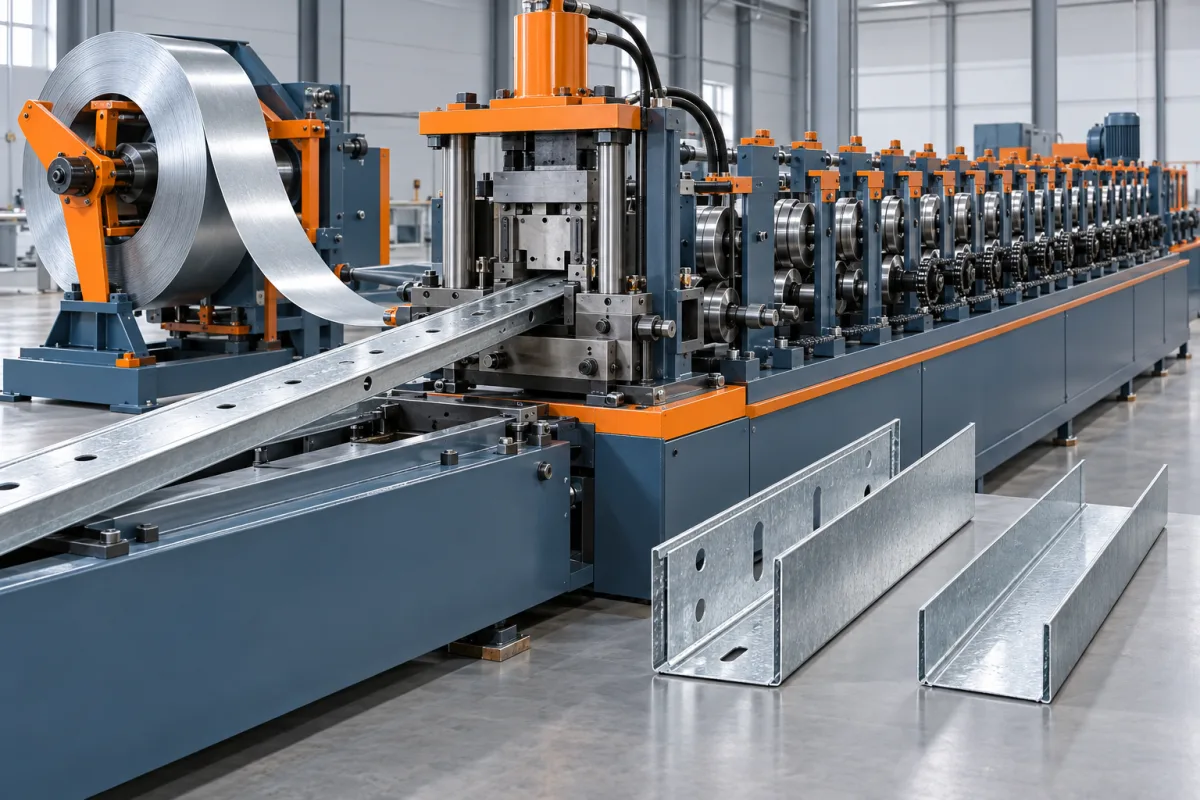
A stud and track roll forming machine is selected to manufacture two cooperating products: the lipped members used as studs and the open channels that receive them. The benefit of a shared route is production flexibility, but its value depends on how reliably the line changes between those products and keeps their dimensional relationship under control.
The best comparison is therefore not simply one machine versus two. It is a comparison of complete order flows: the stud quantities, matching track quantities, size changes, feature requirements and handling needed to deliver a usable framing package. A combined line should earn its place through that practical production plan.
What must a combined stud-and-track line actually produce?
Define each section separately even when they are sold as a matched family. Studs commonly contain return lips, while tracks need an open receiving channel. Their nominal sizes may correspond, but their tooling targets and functional dimensions are not identical.
Include the complete catalogue: widths, flanges, lips, material combinations and required features. If the business supplies both ordinary partition sections and other framing products, separate those families in the scope. A general stud-and-track label should not hide a substantially broader material or geometry requirement.
Why does paired geometry matter?
The track opening must accommodate the specified stud within the intended connection. That relationship involves the complete formed shapes, not just their nominal web dimensions. Bend radii, flange condition, material thickness and end distortion can all influence fit.
Use controlled drawings for both products and state the measurement convention. Identify which dimensions are internal, external or referenced to another surface. The production team should not need to infer a clearance from a catalogue name or from a single hand-adjusted sample.
- Stud web, flange and lip dimensions.
- Track receiving width and leg dimensions.
- Material and coating combinations for both products.
- Specified features and their finished datums.
- Required lengths and end condition.
- Representative assembly components and fit criteria.
Which shared-machine arrangements should be compared?
A proposal may use adjustable tooling, changeable tooling or separate forming paths that share other equipment. Those are different production arrangements. Ask the supplier to show how the stud lips are formed, how the track route differs and which equipment is common to both.
A shared payoff or cutoff can reduce duplication but can also establish a scheduling constraint. Separate paths do not automatically mean simultaneous production. The control, drive, entry and discharge arrangement must support that claim if concurrent operation is part of the business plan.
For a tool-change arrangement, identify storage, lifting or handling needs for the change parts. The floor plan and operator procedure should reflect the actual work involved, not only the compact footprint of the machine in its running state.
What should a complete changeover demonstration include?
Start with accepted studs, change to the specified track, inspect the first accepted track and then return to the original stud setup. Include all roll, guide, punching, cutoff and control changes required. This return test reveals whether settings can be recovered rather than merely reached once during commissioning.
Record the number of people involved, required tools, setup scrap and inspection time. A claimed mechanical adjustment time may omit the steps that matter to the production schedule. First-good-product time is the more useful measure when many short orders are expected.
Test a meaningful transition from the intended catalogue. Changing only length does not demonstrate a stud-to-track conversion, and moving between two conveniently similar widths may not represent the most demanding regular order change.
How should punching requirements be separated?
Studs may need service openings, while tracks may need another hole or slot pattern or no punching at all. State those requirements by product. Ask how unused tools are bypassed or changed and how the controller selects the correct feature program.
Feature locations should reference the finished member rather than an ambiguous flat-strip position. Inspect them after forming and cutting, including near the ends where permitted. Different products should not inherit one default pitch merely because the same machine processes them.
Scrap removal, access and tool condition also affect everyday reliability. Include them in the layout and maintenance discussion. Any physical inspection or adjustment must follow the maker's safe isolation procedure and be performed by appropriately authorized personnel.
What material range can one arrangement cover?
List the actual combinations of grade, thickness, strip width and finish. The stud and track may use different material specifications, so the coil-change process deserves attention alongside section changeover. A machine's broad thickness statement should not replace a product-by-product production envelope.
Trial the combinations that represent normal and demanding work. Record springback-related dimensional behavior, coating condition and cut-end quality. If a proposed setup uses one material for the entire demonstration, identify which catalogue combinations remain unproven rather than assuming identical results.
How does order mix influence the equipment decision?
A factory supplying large repeat orders may benefit from dedicated production even when a shared machine can make both products. Another business with limited volume and varied demand may prefer a combined route. The deciding information is the frequency and duration of real changes, not the number of product names on a brochure.
Build a sample weekly schedule using expected stud and track quantities, lengths and materials. Grouping similar orders can reduce transitions, but it may increase finished-stock requirements or delay a matched delivery. Compare those tradeoffs explicitly instead of evaluating the former independently of the warehouse.
For arithmetic only, a project needing 1,000 studs and 200 tracks is not completed by making 1,200 interchangeable members. The two quantities must be produced, checked and identified separately. A useful output study follows the matched order through to dispatch-ready bundles.
What should collection and labelling prevent?
The handling system must keep product type, width, thickness and length distinct. Studs and tracks may nest differently and require different stacking supports. Verify both arrangements rather than demonstrating only the easier section.
Labels should support the customer's ordering and installation method. For stock supply, size and material identification may dominate. For project supply, order and assembly references can be more useful. Provide a clear route for startup scrap and rejected parts so they cannot rejoin accepted bundles.
How should dimensional problems be diagnosed?
Separate stud geometry, track geometry and the assembled interface. If a pair does not fit, measure both products against their drawings before changing either setup. Otherwise, an incorrect track may be made to fit an incorrect stud while both move farther from the intended specification.
Compare the beginning, middle and ends of representative lengths. End flare points toward a different investigation from a persistent width error or twist. Record whether the issue began after a coil change, section change or tool intervention; that context makes the measurements more useful.
Retain setup sheets and accepted reference parts for each configuration. A shared line has more transitions to manage, so a repeatable recovery method is an important part of its productive capability.
What belongs in the quotation comparison?
Ask each proposal to cover the same stud and track matrix. Include payoff, forming tools, required punches, cutoff components, controls, collection, gauges and change-part storage. Identify training and commissioning deliverables, particularly the changeover procedures that the production team will use.
Future products should have their own assumptions. Clarify whether an additional size uses existing adjustments, new tools or a different route. A low-cost initial package may be sensible for a narrow range, but it should not be mistaken for an unrestricted platform for every framing section.
What should acceptance prove across both products?
- Confirm drawings, material identity and measurement methods for the paired catalogue.
- Produce representative studs and tracks, including required features.
- Measure section geometry, length, straightness and cut ends.
- Check the specified stud-to-track interface.
- Demonstrate stud-to-track and return changeovers.
- Verify collection, counting and identification for each section.
- Report accepted output, changeover time, scrap and remaining deviations.
A successful trial leaves the team with reproducible settings and evidence for both routes. It should not depend on an undocumented setup that only the commissioning technician can repeat.
Frequently asked questions
Does combined production mean both products run at once?
Not necessarily. Many arrangements share equipment and run one section at a time. Simultaneous production requires the corresponding feed, drive, control and discharge capacity. Ask for the actual operating arrangement rather than inferring it from two product pictures.
Is a stud-to-track change only a software command?
Only where the proposed mechanical configuration supports that specific transition. Other arrangements need roll, guide, punch or cutoff changes. Demonstrate the full first-good-product process using the intended catalogue.
Should studs and tracks use the same coil?
Follow the material specifications for the products. They may differ in width, thickness or grade. Include the necessary coil changes in production planning rather than choosing material solely to simplify machine operation.
Why inspect the pair as well as each section?
Individual measurements verify the drawings, while the paired check confirms the intended interface. Both are useful. A forced fit can conceal dimensional errors and should not replace controlled measurements.
When are separate machines worth considering?
Consider them when sustained demand, frequent changes or delivery scheduling makes a shared route restrictive. Compare complete order output, staffing, floor space and stock requirements rather than assuming either arrangement is always more economical.
What information is needed first?
Provide the stud-and-track size matrix, drawings, materials, features, lengths and realistic order mix. Add bundling and labelling needs. That information supports a meaningful comparison of shared and dedicated production routes.

Continue your research
- Stud & Track Roll Forming Machines
- Drywall Stud Roll Forming Machine
- Drywall Track Roll Forming Machine
- C89 Light Gauge Steel Framing Machine
- C140 Light Gauge Steel Framing Machine
- Top Hat Light Steel Framing Machine
- How Stud and track roll forming machine Works
- How To Choose a Stud and track roll forming machine
- Stud and track roll forming machine Price: What Affects the Cost?
Configuration & specification inputs
Match the configuration to your section drawing, material and production requirements.
| Parameter | Requirement / confirmation needed |
|---|---|
| Profile geometry | Paired lipped studs and open receiving tracks with controlled mating dimensions |
| Material | Specify stud and track coil requirements separately |
| Thickness & grade | Catalogue matrix covering material and section combinations for both products |
| Process route | Shared or separate configured paths with product-specific features, cutoff and collection |
| Cutting | Verify support and cutting components for both stud and track sections |
| Output | Matched accepted stud and track orders including all production transitions |
| Electrical supply | Confirm loads and utilities for the actual shared-equipment arrangement |
| Acceptance | Measure both products, test paired fit and demonstrate stud-to-track-to-stud recovery |