
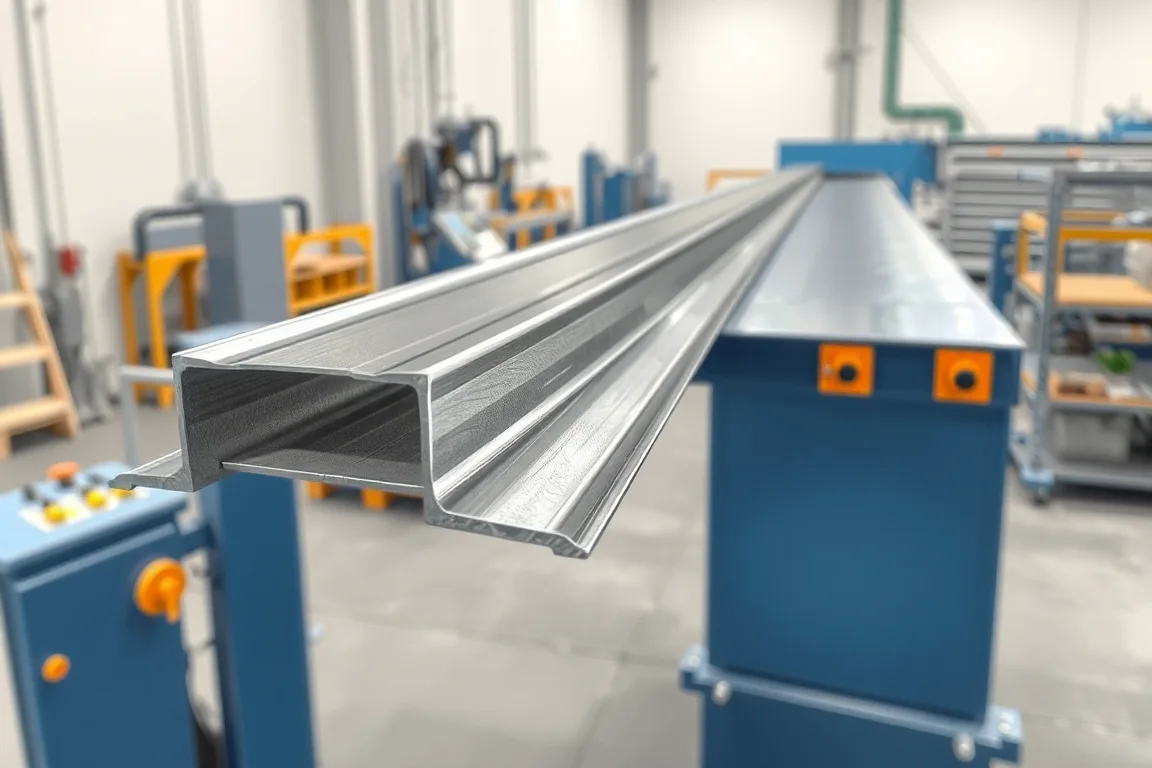
What a Mezzanine Floor Beam Roll Forming Machine Does
A mezzanine floor beam roll forming machine turns flat steel strip into the structural beams that carry a raised walking surface within a rack-supported or rack-assisted mezzanine. The machine’s job is not simply to produce a channel or a box section; it produces a beam whose end connectors, hole patterns, stiffeners and mating faces will later engage uprights, brackets and decking. The profile itself is one output, but the beam’s usefulness depends on how consistently the forming and punching operations preserve the datums that govern assembly.
This page covers the application-specific profile, not a generic pallet rack beam or a storage upright. The known field strings for this application describe a structural member with engineered loads and connections. They also note that cold forming may or may not be the selected route, and that secondary stiffeners or joints may be required. That distinction matters because a mezzanine beam is often a built-up member rather than a single formed section.
Component Interfaces That Define the Profile
The mezzanine floor beam interfaces with several other components. At each end, it may connect to an upright or a beam bracket through a connector plate, a welded end detail or a bolted joint. Along its length, it may receive decking, floor panels, purlins or secondary joists. The profile therefore needs features that locate those parts: a shelf return that supports decking, a mating face that seats against a connector, and a hole pattern that aligns with the upright’s perforations.
Because these interfaces are geometric, the beam drawing usually controls more than overall height and width. It controls the position of the connector holes relative to the beam end, the flatness of the mating face, the squareness of the end cut, and the depth or angle of any return flange. A roll forming machine that produces an attractive section but drifts on hole position can still create field problems.
Production Routes: Cold Forming Versus Built-Up Alternatives
Cold roll forming is a common route for mezzanine beams, but it is not the only one. A beam can be formed as a single open section, formed as two half-sections and joined into a box, or produced as a welded assembly from formed and flat components. The choice affects the machine scope. A single-section route may require punching before forming, then cutoff. A built-up box beam route adds a joining operation, often welding or mechanical fastening, and may require separate handling and alignment fixtures.
The buyer should confirm which route is intended before comparing equipment. A complete production line for a welded box beam includes more than a forming mill; it includes the welding or assembly station and the inspection steps that follow. Comparing that line against a bare forming mill would be misleading.
Punching and Hole Pattern Strategy
Punching is often the first operation in the sequence because holes are easier to place accurately in flat strip than after forming. The machine may use a dedicated punching station, a pre-punch press or an integrated punch-and-form arrangement. Each hole type should be defined by its function: connector holes, stiffener holes, decking attachment holes or handling holes. The datum for each hole should be stated on the drawing, because datums determine how the finished beam aligns with its mating components.
Repeated holes are a common inspection point. If the punch tooling wears or the strip tracking drifts, hole position can shift across a production run. That shift may not be visible in a single sample but will show up when beams are assembled with uprights. The acceptance check should therefore include a representative sample from steady production, not only a first-off piece.
Forming, Cutoff and End Quality
The forming passes shape the strip into the beam section. The number and arrangement of passes depend on the profile complexity, the material grade and thickness, and the required surface finish. A simple channel may need fewer passes than a section with returns, stiffening ribs or a closed box geometry. The cutoff operation then separates the formed beam at the required length. Cut length accuracy and end squareness matter because the beam ends often carry the connection details.
Some profiles require secondary operations after cutoff, such as notching, drilling or end milling. The equipment scope should list these operations explicitly. If the drawing calls for a welded end plate or a stiffener, that work belongs to the assembly boundary, not to the forming machine by default.
Assembly Boundaries and Secondary Operations
It is useful to separate component production from assembly, certification and in-service performance. The roll forming machine produces a component: a formed beam with holes and cut ends. Assembly may involve attaching end connectors, welding stiffeners, joining half-sections into a box, or adding brackets. Certification and load capacity are properties of the finished racking system, established through engineering design and, where required, testing of the assembled structure.
A machine trial does not establish the load capacity of a mezzanine floor. It can verify that the beam geometry matches the drawing and that connections engage as intended. The floor’s load capacity and serviceability require the engineered system design, which considers the beam, uprights, connectors, decking and bracing together.
Inspection for Application-Specific Acceptance
Acceptance checks should focus on the features that affect assembly and in-service behavior. Straightness along the beam length, squareness of the ends, connector hole position and the flatness of mating surfaces are typical. For a built-up box beam, the joining operation introduces additional checks: alignment of the half-sections, weld quality or fastener tightness, and the absence of distortion that could affect the connector fit.
The test beam connector engagement with the upright is a practical check. If the connector does not seat or if holes do not align, the beam will not assemble correctly. Inspect repeated holes across a sample to confirm that the punching operation is stable. Measure section straightness with the agreed gauges. These checks are qualitative in the sense that they compare the produced part to the drawing, not to an invented rating.
Material and Finish Considerations
The known field strings call for specified structural steel with an agreed post-forming finish. The material grade and thickness are buyer-specified, and the operating range requires supplier verification. The finish sequence matters because some finishes are applied before forming, some after, and some after assembly. A pre-coated strip may require careful handling to avoid surface damage during forming, while a post-forming finish may require a separate process step that is not part of the forming machine scope.
For each component, record the grade, thickness and finish sequence. A shelf panel and a structural upright can need very different strip and tooling requirements, even if they are part of the same mezzanine system. The beam drawing should state the material and finish expected for that specific component.
Comparing Equipment Options Without Invented Ratings
When comparing mezzanine floor beam roll forming machine options, buyers can evaluate the written scope rather than numerical claims. A useful comparison separates punch tooling, roll tools, welding or assembly scope, and automatic handling. It also distinguishes a complete component line from a bare forming mill. The buyer can ask how the machine handles tool changes for different beam sizes or connector patterns, and whether the demonstration uses the intended products or an easier substitute.
Production targets should be defined as accepted output per shift with the actual profile and material. Punch density, welded assemblies and batch sizes affect throughput. No verified model rating is supplied here, and none should be inferred from the application description. The equipment schedule should confirm installed power, and the buyer should state voltage, frequency and phase.
Practical Checklist Before Approving a Production Line
- Confirm the exact beam drawing, including connector-hole pattern, mating geometry and shelf returns.
- State the material grade, base-metal thickness and finish sequence for each component.
- Define each hole type and its datum on the drawing.
- Review the process route: punching, section forming, cutoff, welding or assembly where required, and inspection.
- Confirm cutoff requirements, including cut lengths, end quality and any secondary operations.
- Separate component production from assembly, certification and in-service performance.
- Run the agreed material and profile during a demonstration, not an easier substitute.
- Inspect first-off pieces and a representative steady-production sample with agreed gauges.
- Test beam connector engagement with the upright and verify repeated hole positions.
- For built-up box beams, include the joining operation and its quality checks.
- Record changeover steps, setup scrap, punching time and unloading time.
- Compare the written equipment scope with all secondary operations needed for a finished part.
FAQ
What makes a mezzanine floor beam different from a pallet rack beam?
A mezzanine floor beam often carries a walking surface and may support decking, floor panels or secondary joists in addition to rack loads. Its profile may include shelf returns or mating faces for those components. A pallet rack beam typically connects to uprights and supports pallets directly. The interface requirements and the need for a floor system can change the profile and the assembly scope.
Can a single roll forming machine produce both the beam and the upright?
Sometimes, but the tooling requirements differ. An upright typically has a complex perforation pattern for beam connections at many heights, while a beam has end connections and a lengthwise profile. The strip width, thickness and roll tooling may not be shared. The buyer should confirm which components the proposed line is intended to produce and whether tool changes are required.
How should hole position be inspected on a formed beam?
Inspection should reference the drawing datums. A practical approach is to measure the distance from a fixed end or mating face to the hole centers, then repeat the check on a sample from steady production. If the punching station drifts, the error may grow across the run. The check should use agreed gauges and confirm that connector engagement is possible.
Is welding part of the roll forming machine scope?
Not necessarily. Some beams are single formed sections that require no welding. Others are built-up box beams that require a joining operation. The equipment scope should state whether welding or assembly stations are included. If they are separate, the buyer should plan for the additional floor space, fixtures and inspection steps.
What does a machine trial prove about floor load capacity?
A machine trial demonstrates that the equipment can produce a component matching the drawing under the agreed conditions. It does not establish the load capacity of a mezzanine floor. Load capacity and serviceability are properties of the engineered system, including beams, uprights, connectors, decking and bracing. Those are established through system design and, where required, structural testing.
How can a buyer compare quotations for these machines?
Compare the written scope item by item: punch tooling, roll tools, cutoff, welding or assembly, handling, and inspection. Check whether the quotation covers a complete component line or only a forming mill. Ask how output is defined and whether it is based on the actual profile and material. Confirm that the demonstration uses the intended products and that acceptance checks are specified.

Continue your research
- Storage Rack & Shelving Roll Forming Machines
- Rack Upright Roll Forming Machine
- Pallet Rack Beam Roll Forming Machine
- Teardrop Rack Upright Roll Forming Machine
- Pallet Rack Box Beam Roll Forming Machine
- Pallet Rack Step Beam Roll Forming Machine
- How Storage rack roll forming machine Works
- How To Choose a Storage rack roll forming machine
- Storage rack roll forming machine Price: What Affects the Cost?
Configuration & specification inputs
Match the configuration to your section drawing, material and production requirements.
| Parameter | Requirement / confirmation needed |
|---|---|
| Profile geometry | A mezzanine beam is a structural member with engineered loads and connections. Confirm whether cold forming is the selected route and which secondary stiffeners or joints are required. |
| Material | Specified structural steel with an agreed post-forming finish |
| Thickness & grade | Buyer to specify base-metal thickness and grade; operating range requires supplier verification. |
| Process route | Punching → section forming → cutoff → welding/assembly where required → inspection |
| Cutting | Confirm profile-supported cutoff, cut lengths, end quality and any secondary operations. |
| Output | Define accepted output per shift with the actual profile and material. |
| Electrical supply | Buyer to state voltage / frequency / phase. Installed power requires a confirmed equipment schedule. |
| Acceptance | Check straightness and connection datums on the completed beam. Establish how supporting floor components seat on it. The floor's load capacity and serviceability require the engineered system design and are not inferred from a machine trial. |