
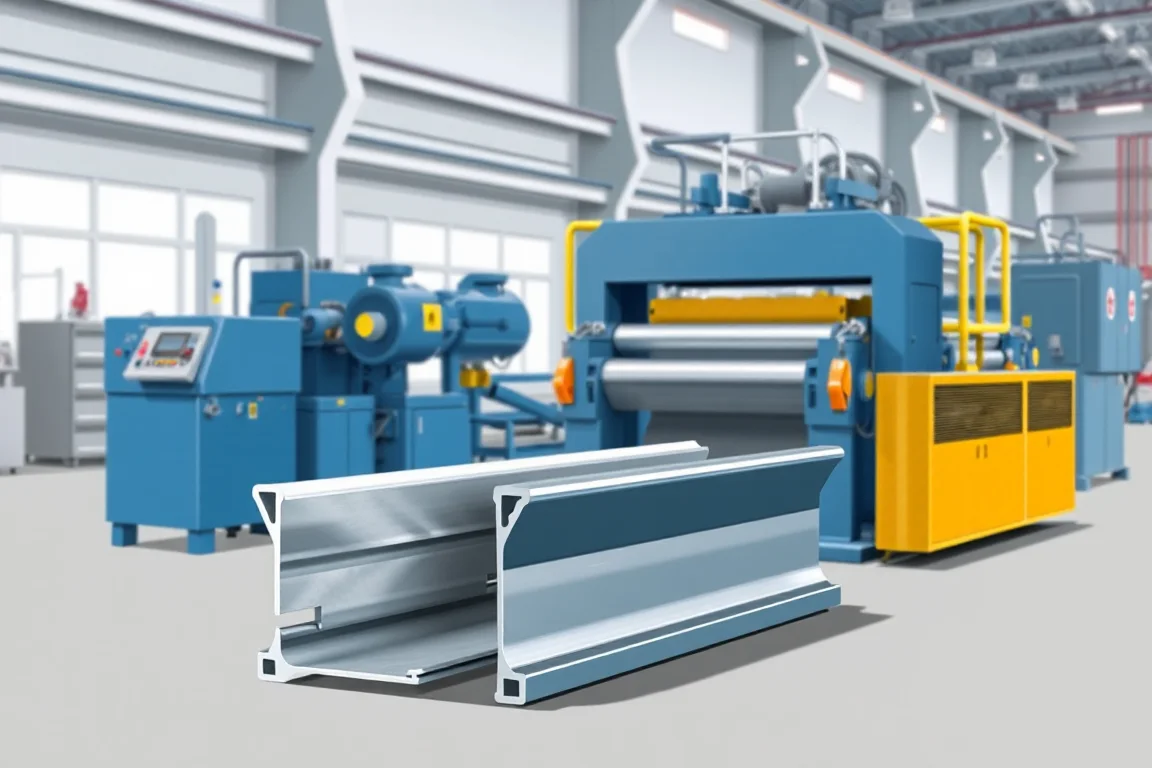
What an omega profile actually is
An omega profile is a constant-cross-section strip product whose name comes from the Greek letter omega. Functionally, it usually combines a central web, two side walls, and outward or inward flanges that create a partially enclosed channel. The critical geometric feature is the narrowed opening or returned edge: the flanges may turn back toward the web or form a slot that is narrower than the interior cavity. That re-entrant shape is what distinguishes an omega profile from a simple hat channel or a plain U channel. A hat channel typically has flanges that extend outward and remain accessible from the open side; an omega profile can hide part of the interior behind an internal return.
This distinction matters because tool access, nesting, and cutoff all depend on the opening. A simplified hat-channel sketch will not show whether a forming roll can reach a bend, whether a punch can approach a hole from the inside, or whether a cutoff blade can enter without deforming the returns. For any manufacturing assessment, the full cross-section should be supplied, including thickness, bend radii, flange lengths, hole positions, and the intended mating interfaces.
Functional datums, mating surfaces, and finished geometry
An omega profile is not defined by every dimension equally. The finished part usually has a small set of functional datums: surfaces that seat against another component, edges that locate into a slot, holes that receive fasteners, and openings that accept a bracket or insert. These features control assembly and load transfer. Other dimensions, such as the exact outer contour of a non-contacting wall, may be less critical to function but still affect appearance, nesting, or fit.
When interpreting a profile drawing, separate the features that must be held in relation to each other from those that can vary within a wider band. For example, the distance between two mounting holes and their position relative to a seating face may determine whether the part assembles. The overall height of a returned edge may be less important if it does not contact another component. This hierarchy should be agreed before tooling is designed, because it influences which bends receive more forming stations and which dimensions are checked most frequently.
Interfaces include any punched holes, notches, embosses, or secondary bends. An omega profile may be used as a structural spacer, a track for a sliding element, a bracket for a panel, or a frame member. Each application changes the critical features. The finished profile is therefore a combination of the formed section and the secondary features, not just the roll-formed shape.
Why the omega form suits roll forming
Roll forming is a progressive bending process that converts flat strip into a constant cross-section by passing it through a series of powered rolls. It suits omega profiles because the shape is uniform along the length and the bends can be developed in sequence. Each pair of rolls performs a small amount of bending, so the strip work-hardens gradually and the final section is formed without the sharp local deformation that can occur in press braking.
The process is economical when the same profile is required in long lengths or high quantities. Once the roll tooling is set, production is continuous and repeatable. However, roll forming is not a universal solution. The shape must be developable from flat strip, the material must tolerate the required bend radii, and the re-entrant features must be accessible to the rolls. If the profile contains closed cavities, undercuts, or severe thickness changes, another process may be more appropriate.
Alternative processes and when they make sense
Press braking is a common alternative for low-volume or prototype omega-like profiles. A press brake forms one bend at a time, which gives flexibility for different lengths and small batches. The limitation is that re-entrant flanges can be difficult to form because the punch or die may collide with the previously formed walls. Press braking also tends to be slower for long runs and can produce more variation between operators.
Stamping can produce complex features and holes in a single stroke, but the tooling is dedicated to a specific shape and thickness. For an omega profile with a constant section, stamping the entire length is usually impractical because of the long, narrow shape. Stamping is more common for short brackets or for adding secondary features to a roll-formed section.
Extrusion is a candidate for nonferrous materials such as aluminum, where a die can produce a constant cross-section with internal returns. Extrusion can create hollow or semi-hollow shapes that roll forming cannot, but it requires a different material input and may have different surface finish and tolerance characteristics. Welded fabrication, using flat plates or bent components joined together, is another route for large or low-quantity parts. It avoids tooling cost but introduces distortion and requires more labor.
The choice depends on the profile geometry, the material, the production volume, and the acceptable cost per part. Roll forming is favored when the section is constant, the bends are accessible, and the volume justifies dedicated tooling.
Production route: from coil to finished profile
The typical route for an omega profile roll forming machine begins with a feasibility review. The profile drawing, material specification, and thickness are evaluated to confirm that the shape can be developed and that the bends can be reached. This review may identify the need for a trial or for design changes such as larger bend radii or modified flange returns.
Coil preparation follows. The strip is unwound, straightened, and sometimes cleaned or lubricated. The strip width and edge condition matter because they affect the final profile dimensions and the forming loads. If the coil has camber or thickness variation, the finished profile may inherit those defects.
Progressive forming is the core operation. The strip passes through a series of roll stands, each of which bends the section a little more toward the final shape. The number of stations depends on the complexity of the omega profile, the material strength, and the thickness. More stations can distribute the bending strain and reduce the risk of cracking or springback, but they also increase tooling cost and changeover time.
Secondary features are added after or during forming. These may include punching holes, notching edges, embossing stiffeners, or forming secondary bends that cannot be created by the main rolls. The sequence is important: a hole punched before a bend may distort, while a hole punched after forming may require access to the re-entrant side.
Cutoff is the final step. The profile is cut to length by a die that supports the section while shearing or sawing. For omega profiles, the cutoff tool must accommodate the re-entrant flanges and any holes near the cut end. The cut quality, burr height, and end squareness are part of the accepted output.
Tooling alternatives for omega profiles
Roll tooling is the primary tooling for the forming operation. The rolls are designed with a specific pass schedule that gradually shapes the strip. For omega profiles, the rolls must reach into the channel to form the inward flanges. This may require smaller roll diameters or side-entry rolls. The tooling can be dedicated to one profile or designed for some adjustability, but adjustable tooling often has limitations in the re-entrant areas.
Punch dies and cutoff dies are separate tooling sets. A punch die may be integrated into the roll forming line or operated as a separate press. Integrating punching into the line can reduce handling and improve accuracy, but it requires synchronization with the forming speed. Cutoff dies can be shear-type or saw-type. Shear cutoff is faster but may deform thin or re-entrant walls; saw cutoff produces a cleaner end but is slower and creates chips.
Feasibility trials are sometimes used before final tooling is committed. A trial can use temporary or adjustable rolls to verify that the material forms without cracking and that the re-entrant features are accessible. The trial also helps establish the pass schedule and the expected springback. A trial is not a substitute for production tooling, but it reduces the risk of a costly tooling error.
Managing changeovers and batch size
Changeover frequency and batch size are major economic factors. Dedicated roll tooling is most economical when the same omega profile runs for long periods. If the machine must switch between different profiles or sizes, the changeover time and setup scrap become significant. Some machines use cassette-style tooling or quick-change roll stands to reduce downtime, but these systems add cost and may limit the rigidity of the forming stands.
For small, varied batches, a press brake or a simpler forming method may be more practical. The decision should include the cost of tooling, the time to change over, the scrap produced during setup, and the labor required. High steady-state speed is less useful if the machine spends most of its time being set up. The production target should be defined as accepted output per shift with the actual profile and material, not as a theoretical line speed.
Inspection and acceptance of the finished profile
Inspection should prioritize functional datums and mating features. The first-off piece should be checked against the drawing, with particular attention to the features that control assembly. A representative sample from steady production should also be inspected to confirm that the process is stable. The measurement method must be documented: whether the section is measured in a free state or restrained state, and which gauges or fixtures are used.
For an omega profile, the re-entrant opening may require special gauges or a coordinate measuring machine to reach internal features. The inspection plan should specify the frequency of checks, the sample size, and the action taken when a dimension drifts. The accepted output should be defined in terms of the complete profile, including secondary features and cut ends. If the profile is used with a specific bracket or fastener, the functional check should use that mating component, and the drawing revision should be recorded with the accepted sample.
Incoming material variation should also be monitored. Changes in thickness, yield strength, or coating can affect springback and final dimensions. For repeat production, the settings should be recorded against the complete material-and-profile combination, so that a future run can be reproduced without trial and error.
Practical checklist for specifying an omega profile roll forming machine
- Provide the full cross-section, not a simplified sketch, including re-entrant flanges, holes, and mating interfaces.
- State the material grade, thickness, and any incoming strip tolerances that may affect forming.
- Identify the functional datums and the features that must be held in relation to each other.
- Confirm whether the process route includes punching, notching, or secondary bending, and where these operations occur.
- Define the cutoff requirements: cut length, end quality, burr limits, and any secondary operations at the cut end.
- Specify the electrical supply and the installed power requirements based on a confirmed equipment schedule.
- Estimate the batch size and changeover frequency to determine whether dedicated or flexible tooling is appropriate.
- Agree on the acceptance checks, measurement method, and the state of the section during inspection.
- Plan for a feasibility trial if the re-entrant features are complex or the material is difficult to form.
- Record settings and tooling details for the material-and-profile combination to support repeat production.
FAQ: omega profile roll forming
What distinguishes an omega profile from a hat channel?
An omega profile typically has returned edges or a narrowed opening that creates a partially enclosed cavity. A hat channel usually has outward flanges with an open side that is fully accessible. The returned edges in an omega profile change tool access and may require special roll or punch designs.
Can any omega profile be roll formed?
No. The profile must be developable from flat strip, and the bends must be reachable by the rolls. Closed cavities, severe undercuts, or thickness changes may make roll forming impractical. A feasibility review with the full cross-section is needed to confirm.
How should I specify the material and thickness?
Provide the base-metal grade, thickness, and any coating or surface finish requirements. The operating range for the machine depends on the material and profile, so the supplier must verify that the proposed tooling can handle the specified combination. Incoming strip tolerances should also be stated.
What is the difference between a shear cutoff and a saw cutoff?
A shear cutoff uses a die to shear the profile, which is fast but can deform thin or re-entrant walls. A saw cutoff cuts with a blade, producing a cleaner end but generating chips and typically operating at a lower speed. The choice depends on the end quality required and the profile geometry.
How often should I inspect the finished profile?
Inspection frequency depends on the production rate and the criticality of the features. At minimum, inspect the first-off piece and a representative sample from steady production. The inspection plan should define the functional datums, the measurement method, and the state of the section during measurement.
When is press braking a better choice than roll forming?
Press braking is often better for low volumes, prototypes, or profiles with complex re-entrant features that are difficult to roll form. It offers flexibility for different lengths and small batches, but it is slower for long runs and may have more variation. The decision should compare total cost, including tooling and labor.

Continue your research
- Custom & Industrial Profile Roll Forming Machines
- Custom Profile Roll Forming Machine
- Hat Channel Roll Forming Machine
- C Channel Production Line
- Z Channel Production Line
- Electrical Cabinet Frame Roll Forming Machine
- How Custom profile roll forming machine Works
- How To Choose a Custom profile roll forming machine
- Custom profile roll forming machine Price: What Affects the Cost?
Configuration & specification inputs
Match the configuration to your section drawing, material and production requirements.
| Parameter | Requirement / confirmation needed |
|---|---|
| Profile geometry | An omega profile can contain returned edges or a narrowed opening that changes tool access. Send the full section, not a simplified hat-channel sketch, when requesting a manufacturing assessment. |
| Material | Specified steel, stainless steel or nonferrous strip after feasibility review |
| Thickness & grade | Buyer to specify base-metal thickness and grade; operating range requires supplier verification. |
| Process route | Feasibility review → coil preparation → progressive forming → secondary features → cutoff |
| Cutting | Confirm profile-supported cutoff, cut lengths, end quality and any secondary operations. |
| Output | Define accepted output per shift with the actual profile and material. |
| Electrical supply | Buyer to state voltage / frequency / phase. Installed power requires a confirmed equipment schedule. |
| Acceptance | Use the intended bracket, fastener or mating section for the functional check. Keep its drawing revision with the accepted profile sample. For repeat production, record settings against the complete material-and-profile combination. |