
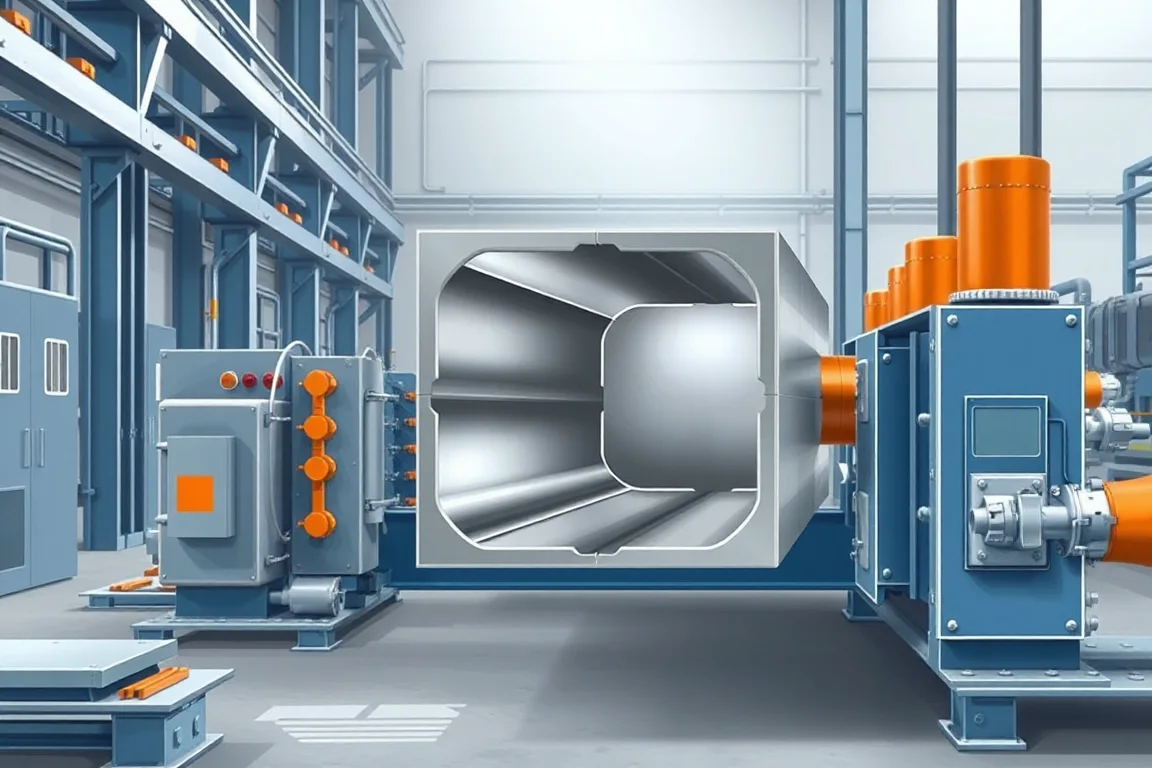
A square downspout is not simply a folded strip. It is a closed, dimensionally stable rectangular tube that must mate with elbows, outlets, brackets and the gutter system it serves. A square downspout roll forming machine is therefore defined as much by its interfaces as by its forming stations. The machine must produce a section whose faces, diagonals, corner radii and seam are consistent enough that downstream fittings assemble without force or leakage paths.
What the square downspout profile actually requires
A square downspout drawing normally specifies two face dimensions, a corner radius, a seam type and a material thickness. In practice the critical inputs are less obvious. The corner radius affects how the strip flows through forming stations and how the seam closes. The seam type — whether a folded lock, a standing seam or a simpler overlap — determines whether the line needs edge preparation, pre-seaming or a closing station. The connector interface at each end determines whether the pipe is cut square, reduced, expanded or left plain for a separate elbow or outlet.
Two faces and a diagonal measurement are the practical way to distinguish acceptable size variation from section distortion. A pipe can be within tolerance on both faces while a diagonal is out, which indicates the section has twisted or the seam has pulled. That distinction matters because a twisted pipe will not slide into an elbow even if its nominal size is correct.
Material choices and why they change the process
Coated steel and aluminum are the common inputs for square downspouts. Coated steel offers stiffness and a familiar forming behavior, but coating type and bend radius affect how the strip tolerates tight corners. Aluminum is lighter and can be formed at similar stations, yet it behaves differently in springback and seam closing, so a tool set proven on steel may not transfer without review.
Copper is sometimes used for architectural downspouts, but it requires its own process review. It work-hardens, it can mark easily, and its joining methods differ from coated steel or aluminum. Treating copper as a drop-in substitute for coated steel is a common source of poor finish and inconsistent seams. The buyer should specify base-metal grade and thickness for the intended profile, and the supplier should confirm the operating range rather than assume one tool set covers all materials.
Forming route: how a closed downspout is produced
The typical process route is coil payoff, section forming, edge or seam closure, cutoff, with outlets or elbows handled as separate operations. Each step has a boundary. The roll forming machine creates the closed section and cuts it to length. It does not usually create the elbow, the outlet, the shoe or the bracket. Those are separate forming or purchased components.
Closed downspout seams and open gutter sections need different forming sequences. A gutter former produces an open profile with a bead or hem; a downspout line produces a closed tube. Confusing the two leads to incorrect expectations about changeover, tooling and cutoff. A square downspout machine may share a coil payoff or a cutoff design with a gutter line, but the forming stations and seam closure are specific to the closed section.
Cutoff, end quality and secondary operations
Cutoff is often underestimated. A profile-supported cutoff must cut the closed section without crushing the walls or leaving a burr that interferes with a connector. The cut length, end squareness and end quality determine whether the pipe can accept an elbow directly or needs a separate end preparation step. If the intended assembly requires a reduced or expanded end, that is a secondary operation and should be listed explicitly in the equipment scope.
Measure the product after cutting, when unsupported walls can reveal distortion. A pipe that looks correct on the line may relax or twist once it is off the machine and unsupported. This is why acceptance checks should include a representative sample, not only a first-off piece.
Assembly boundaries: what the machine does not make
A square downspout roll forming machine forms the pipe. Elbows, outlets, shoes and brackets are separate products with their own tooling or supply chain. If the business intends to offer complete downspout assemblies, the production plan must account for those secondary items. Some can be purchased; some may justify dedicated forming equipment. The decision depends on volume, variety and whether the joint interface is proprietary.
This boundary also affects quoting. A line that produces pipe quickly but leaves every end needing manual fitting preparation may not deliver the intended installed productivity. Compare the written equipment scope with all secondary operations needed for a finished part.
Site or workshop production: choosing the right route
Portable gutter work includes coil loading, site access and support of long runs. A workshop line is different: it depends on coil handling, floor space, cutoff speed and the ability to stage finished pipe. Workshop line speed is only one part of installed productivity. Changeover time, setup scrap, punching and unloading time also shape real output.
For square downspouts, portability is less common than for gutters because the closed section and seam closure need more forming stations. A fixed workshop line is often the practical choice when the product is cut to length and shipped. A portable arrangement may suit short runs or on-site fabrication, but it still needs a defined cutoff and a way to handle the finished pipe without distortion.
Inspection and acceptance checks
Inspection should follow the interfaces, not just the nominal size. Check the bead or hem if the profile includes one, the straightness of the pipe, and the joining fit. For downpipes, check the seam and the mating outlets or elbows. Test the pipe against the intended elbows and connectors. Determine whether end reduction or other fitting preparation is a separate machine. Measure the product after cutting, when unsupported walls can reveal distortion.
A practical acceptance check includes first-off pieces and a representative steady-production sample measured with the agreed gauges. Record changeover steps, setup scrap and unloading time. The goal is not to find one good piece but to confirm the line can repeat the agreed quality across a run.
Practical checklist before approving a production line
- Confirm the profile drawing includes both face dimensions, corner radius, seam type and connector interface.
- State the base-metal grade and thickness for each material to be run, and ask the supplier to confirm the operating range.
- List every secondary operation needed for a finished downspout: elbows, outlets, end reduction, punching, brackets.
- Define cutoff requirements, including cut length, end squareness and acceptable burr or deformation.
- Inspect the bead or hem, straightness and joining fit on a representative sample.
- Test the pipe against the intended elbows and connectors before acceptance.
- Measure the product after cutting, when unsupported walls can reveal distortion.
- Compare the written equipment scope with all secondary operations needed for a finished part.
- Define accepted output per shift with the actual profile and material, not a demonstration substitute.
- Confirm electrical supply voltage, frequency and phase, and request a confirmed equipment schedule for installed power.
Alternatives and how they compare
A square downspout roll forming machine sits alongside several related lines. A round downspout roll forming machine produces a circular section with a different seam and connector strategy. A rectangular downpipe roll forming machine may produce a similar closed section but with different proportions and corner treatment. A box gutter roll forming machine produces an open box profile, not a closed downspout, and should not be expected to make downpipe sections.
Half round and K-style gutter machines are also distinct. They form open gutter profiles with beads or hems, and they do not establish a closed downpipe seam. Choosing between these routes depends on the complete roof drainage detail and the selected material. A gutter former does not establish drainage capacity, and a downpipe former does not necessarily make elbows. The machine is one part of a system.
When comparing square downspout production options, consider whether the intended product is a standard size or a range of sizes, whether the material will change, and whether secondary operations will be in-house or purchased. A line with more forming stations may handle tighter corner radii or heavier material, but it may also be less portable and slower to change over. The right choice is the one that matches the finished part and the business model, not the one with the longest feature list.
FAQ
Can a square downspout roll forming machine also make round downspouts?
Generally no. A round downspout requires a different forming sequence and a different seam and connector approach. The tooling and stations are specific to the section shape. If both products are needed, they are usually separate lines or separate tool sets with a defined changeover procedure.
Does the machine produce elbows and outlets as well?
Not typically. Elbow production normally requires a defined secondary forming process or a purchased component. The roll forming machine produces the straight pipe section. End preparation such as reduction or expansion is also a separate operation unless it is explicitly included in the equipment scope.
How do I check whether the section is twisted or just a different size?
Measure both faces and the diagonals. If both faces are within tolerance but the diagonals differ, the section has distorted or twisted. If both faces and diagonals are proportionally different, it may be a size variation. This distinction tells you whether to adjust forming or investigate the seam and cooling.
Can one tool set run coated steel, aluminum and copper?
Do not assume one tool set handles steel, aluminum and copper equally. Each material has different springback, marking risk and joining behavior. Copper in particular requires its own process review. The supplier should confirm the operating range for each material rather than treating them as interchangeable.
What should I inspect on a finished square downspout?
Inspect the bead or hem if present, the straightness of the pipe, and the joining fit. For downpipes, check the seam and the mating outlets or elbows. Test the pipe against the intended connectors, and measure after cutting because unsupported walls can reveal distortion.
How is output defined for a square downspout line?
Define accepted output per shift with the actual profile and material. Line speed alone is not a reliable measure because changeover, setup scrap, punching and unloading time all affect real productivity. Use a representative sample and agreed gauges to confirm the line can repeat the required quality.

Continue your research
- Gutter & Downspout Roll Forming Machines
- Gutter Roll Forming Machine
- Downspout Roll Forming Machine
- K Style Gutter Roll Forming Machine
- Half Round Gutter Roll Forming Machine
- Box Gutter Roll Forming Machine
- How Gutter roll forming machine Works
- How To Choose a Gutter roll forming machine
- Gutter roll forming machine Price: What Affects the Cost?
Configuration & specification inputs
Match the configuration to your section drawing, material and production requirements.
| Parameter | Requirement / confirmation needed |
|---|---|
| Profile geometry | A square downspout needs corner-radius, seam and connector definitions. Measure both faces and diagonals to distinguish size variation from section distortion. |
| Material | Coated steel or aluminum; copper requires its own process review |
| Thickness & grade | Buyer to specify base-metal thickness and grade; operating range requires supplier verification. |
| Process route | Coil payoff → section forming → edge/seam closure → cutoff → outlets or elbows as separate operations |
| Cutting | Confirm profile-supported cutoff, cut lengths, end quality and any secondary operations. |
| Output | Define accepted output per shift with the actual profile and material. |
| Electrical supply | Buyer to state voltage / frequency / phase. Installed power requires a confirmed equipment schedule. |
| Acceptance | Test the pipe against the intended elbows and connectors. Determine whether end reduction or other fitting preparation is a separate machine. Measure the product after cutting, when unsupported walls can reveal distortion. |